Bloglovin

Follow on Bloglovin

Wednesday, October 9, 2013

Estimating Division Problems: Compatible Numbers

My class is learning how to divide two- and three-digit numbers by one-digit numbers. First, we worked on dividing multiples of 10 and 100, then we moved on to estimating quotients using compatible numbers. Teachers sometimes skip this skill because they find it confusing. In my mind, though, it's an essential process for conceptualizing division and determining reasonableness.

You're probably thinking that I'm back on my estimation and reasonableness soapbox, and you're right about that! Here's how estimating with compatible numbers looks:


If kids learn to ask themselves the right questions, they can become great mathematicians. In this case, the question is simply, "What multiple of [the divisor] is closest to the first one or two digits of [the dividend]? Once they know that, they can quickly estimate the quotient.

At this point, some students may say, "I know the actual answer." And it's true, once a student has conceptualized this process, he or she may be able to take the next step and mentally think, "If 240 divided by 8 is 30, I'll have 17 left (because 257 minus 240 is 17). 17 divided by 8 is 2, remainder 1. Therefore, 257 divided by 8 must be 32, remainder 1."

After working with multiples of 10 and 100, as well as compatible numbers, my students are now ready to learn the common division algorithm. Wait! No, it's more than that! My students are now ready to understand the common division algorithm.

Saturday, October 5, 2013

Folklore for Halloween

There's no better way to link the study of folklore to Halloween than the legend of the headless horseman!

“Icabod Pursued by the Headless Horseman” by F.O.C. Darley
Source: Le Magasin Pittoresque, 1849, Public Domain

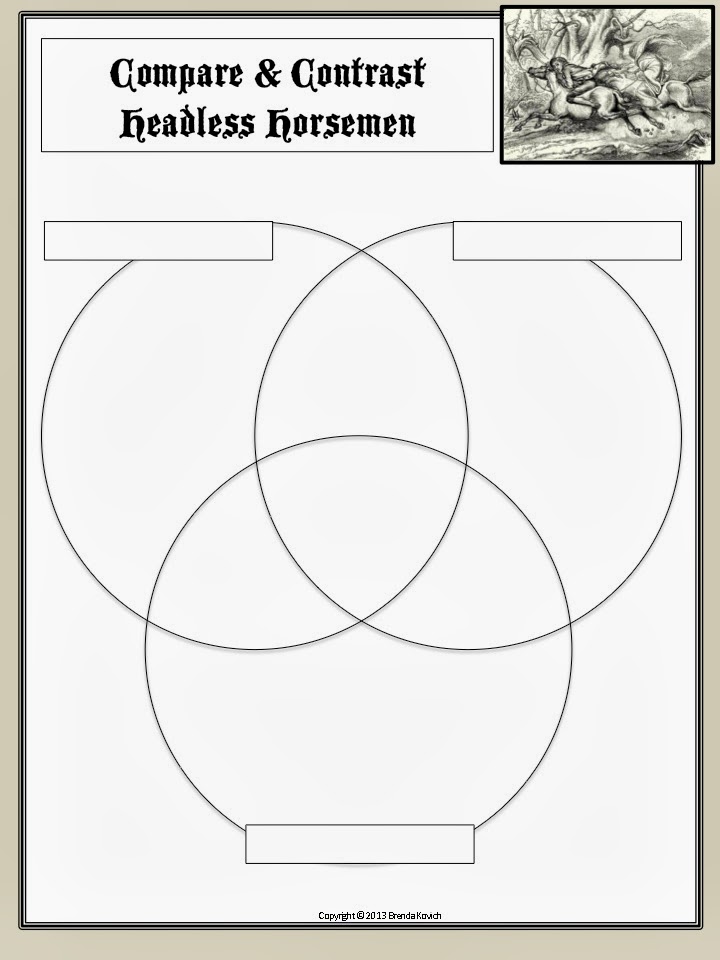
This morning I let my fingers do the walking (through the Internet) in search of kid-friendly versions of this widely-told legend. This Wikipedia article gave me some good background information and turned me in the right direction. I found a kid-friendly version of "The Legend of Sleepy Hollow" (retold by Anne Collins), as well as texts about the dullahan (Irish folktale), Ewan-of the-Small-Head (Scottish folktale) , and the dund (Indian folklore). These stories will give my students much-needed practice in comparing and contrasting traditional literature (RL.4.9).


As I continued my search on YouTube, I really hit the jackpot! Both Snickers and Walt Disney have created and posted advertisements that include parodies of the headless horseman. My students will have so much fun comparing these visual presentations with the written texts (RL.4.7).


 Dozens of other instructional ideas swirled around in my head. Maybe I'll have my students write their own versions of the headless horseman story. Or they could create skits to depict the folktales. This timeless tale is sure to motivate my students this Halloween! Won't you join us?

Thursday, October 3, 2013

Mix or Match?

My class has been working on a sequential paragraph called "How to Carve a Pumpkin." Yesterday they wrote a variety of possible beginnings (question, dialogue, onomatopoeia, surprise statement, etc.) and endings. They've already drafted the steps, so today's the day they'll put it all together. But here's the question:

Should students mix or match their beginnings and endings?

It was apparent yesterday that many students thought that if they began with a question, they had to end with the answer, and if they began with onomatopoeia, they had to end with onomatopoeia too. Since we use a sandwich analogy for our paragraphs, they have heard me say, "You can't put a hot dog bun on top and a hamburger bun on the bottom." But is that what I really mean?

To help them focus on how the conclusion should logically follow the introduction, we'll try this activity first. 


Exploring the writing process really benefits my students, but sometimes, when we break the writing into little pieces, it's hard to put the whole thing back together again to establish a smooth, flowing piece. How do you address this quandary in your classroom? Please comment and let me know.


Tuesday, October 1, 2013

Teaching 2-Digit by 2-Digit Multiplication

Common Core State Standard 4.NBT.B.5 asks fourth graders to "multiply two two-digit numbers, using strategies based on place value and the properties of operations..." How can this be achieved?

Once your students understand the distributive property and can apply it to multiplication of multiple-digit numbers by single-digit numbers, there's no holding them back! (See my September 14th blog post to learn more about the distributive property and multiplication.)

The graphic below illustrates how to break two-digit multiplication into manageable chunks:
  1. Show students how the bottom number in the problem can be decomposed into tens and ones. For example, in the problem below, 43 x 28 = 43 x (20 + 8). Using the distributive property, we also know that this equals (43 x 20) + (43 x 8).
  2. Explain that we reverse the ones and tens because that's how we'll do it in the shortcut (AKA algorithm).
  3. Let the students know that we are using these same steps in the algorithm, but we're simply stacking them to make our lives simpler and easier.
  4. Demonstrate using the same problem. Kids will do much, much better if they're given a small square to cover one digit so they can focus on one part of the problem at a time. (I sometimes use centimeter cubes as well.)
  5. Practice, practice, practice! First, demonstrate; second, do problems together; third, support them while they work the problems independently; fourth, send them on their merry way! It's just like riding a bicycle!

Using graph paper for newbies to long multiplication is essential. You can download graph paper for free at Incompetech.com. Just click on square then choose the size you want. (I usually choose one centimeter.) Super Teacher Worksheets also offers a cute (free!) doggie themed problem set on graph paper. 

Long multiplication? It's a breeze! Let's get started!


Monday, September 30, 2013

Speaking the Language of Math

It's time for my students to learn the language of math, beginning with vocabulary relating to four basic operations: addition, subtraction, multiplication, and division. After all, it's hard to complete a problem if you don't know what the words mean. For example,
  • Name the factors of 24.
  • What is the sum of 6 and 4?
  • Find the difference between 16 and 6?
Each student will receive this sheet, and I'll test them later this week. This way, I can be sure that they all know the language of math!


Many more math vocabulary lessons and assessments will pop up this year, too: measurement terms, properties, shapes, etc. They need to be able to walk the walk AND talk the talk.

Saturday, September 28, 2013

Thematic Teaching with Trees 2

Our tree day was a smashing success!


Students spent more than two hours planning, drafting, editing, and illustrating their personifications of trees. One of the most difficult parts of the assignment was giving a tree human qualities but not making it a human in a tree's body. After extensive planning, some children reverted to writing about a tree as just a tree while others simply made their trees talk. Fortunately, we could look back at the planning sheets and work together to make their choices in figurative language more effective.

Mid-day we explored factor trees and completed a close read about how leaves change in fall. Then after lunch, students cut and mashed leaves (red and green) for our chromotography experiment. I added a bit of isopropyl alcohol, and we let them set for one hour. Next they cut coffee filter strips and awaited the results. This step took longer than anticipated. I thought we'd be able to see the lines clearly after about fifteen minutes. In reality, it took about an hour, but the results were spectacular! Students could really see that chlorophyll leaves the leaf after food production is finished for the summer.


Since my class is learning how to conduct valid scientific investigations, I made sure to control as many variables as possible for this experiment. All leaves came from the same burning bush. We used the same type of cups, and the isopropyl alcohol was the same temperature for both cups. 

Have you tried this experiment with success in your classroom? Please share by commenting! I'd love to know how you did it.

P.S. We decided to leave the filter paper in the liquid over the weekend and see what happened. Guess what?


Wow! With science, sometimes patience really pays off!

Thursday, September 26, 2013

Thematic Teaching with Trees

In preparation for the fall ball, the maple shed her green summer frock and donned a magnificent magenta cloak.

Tomorrow, my fourth grade class will have some fun with trees.

Activity #1 - Writing: Personification of a Tree
     Each student will use this organizer to plan three to five sentences that personify a specific tree. He/she will sketch the tree's trunk and branches then print the sentences across the page. Finally, after outlining everything in black, the student will color the trunk and sponge paint leaves onto the picture.


Activity #2 - Reading
     Students in my class will read Why Leaves Change Color (North Carolina Testing Program). This brief one-page piece fits well with the longer personification piece. Other options include Why Leaves Change Color, a one-page text written by Stephen Caney, and Autumn Leaves and Fall Color (posted by Science Made Simple).

Activity #3 - Math
     Factor Trees (MathAids.Com) provide an essential link in learning about multiplication and division.

Activity #4 - Science
     Each group will cut and mash a particular leaf, pour isopropyl alcohol over it, wait one hour, and extrapolate colors using coffee filters. You can see examples of how this works in two videos: Time for Me to Leaf (8:45) and Leaf Color Chromatography (4:24).

Activity #5 - Social Studies
     I will supply each group with projected dates for peak fall colors, as shown below. They will cut out the states and dates, arrange them in similar piles, then create a map (with  a key) to show when peak colors will appear in each state. You can download a free map from Free US and World Maps.com by clicking here.


Want to infuse a little excitement into learning this fall? Try thematic teaching with trees!