Bloglovin

Follow on Bloglovin

Saturday, November 29, 2014

Opinion and Persuasive Paragraphs (Greek Myth Style!)

Excitement about Greek mythology was at an all-time high as we sadly ended our unit. It was time to move into comparing and contrasting folklore and writing persuasive essays. "I wish I could bottle their enthusiasm," I sighed. Then it hit me! We could segue into opinion writing with paragraphs about characters in Greek mythology!

Our first discussion centered around persuasive techniques from another famous Greek fellow, Aristotle.


Then I introduced a simple organizer used for argumentative writing.


Modeling was my next step. (Note: This step is essential to exemplary student writing. Don't skip it!) I used the organizer to plan a basic paragraph then set to work with some strategies that really strengthened my writing.


Students planned opinion pieces to explain the character from Greek mythology they would choose to invite to dinner. The next day, I introduced the differences between opinion and persuasive writing (first person focus versus third person focus; call to action in persuasive), and they planned persuasive pieces on which character to elect as president.

After that, they were allowed to choose which piece to finalize. Just look at some of these paragraphs! I'm so proud of them!


One of my colleagues wanted to try this with characters from stories her students had read this year. She inspired Opinion and Persuasive Paragraphs Featuring Characters from Literature. Thanks, Gretchen!

Enjoy!
Brenda


Friday, November 14, 2014

Greek Mythology Character Sheets

My class is having a blast with Greek mythology! I have never seen them so excited about reading. The goal of our first project was getting to know the mythological characters. I gave each of them a blank research template, and they set to work. Take a peek at our finished products:


Every day I find students milling around the display, reading and discussing. "Wow! This one throws lightning bolts!" or "I read about this one in a different myth," can be heard.

After we began this project, I found some awesome clip art by EduClips and decided to publish a set of Greek Mythology Coloring and Research Sheets. (A blank template for those who want to draw their own pictures is also included.)


Enjoy!
Brenda

Wednesday, November 5, 2014

Place Value Strips (4.NBT.A.1 & 5.NBT.A.1)

More place value! Earlier this year, we worked on whole number numeration; now we're up to our elbows in decimals. In addition to daily lessons, students are getting their daily dose of decimals and explaining the answer. Every day.


Day by day, they're getting stronger. But we still run into a few snags. Students attending yesterday's morning tutoring session requested more practice on multiplying and dividing by 10 and 100. If you've read any of my other posts on numeration, you know that Beyonce's song, "Irreplaceable," helps us with this one:

To the left, to the left
Everything's ten times in the place to the left... 

To multiply by ten on paper, however, we typically move the decimal point to the right. Ugh! That's confusing! My morning tutor buddies needed to move back to something more tangible, so we made some place value strips. It was easy and effective.
  1. Cut sentence strips into two-inch pieces.
  2. Give each student a whole sentence strip and ten two-inch pieces.
  3. Have each student make a decimal point in the center of the sentence strip then mark five place values (two-inch lines made with a ruler and a marker) on each side of the decimal point.
  4. On the two-inch pieces, have them write the numerals 0-9.


Here's an abbreviated version of what happened in our tutoring session:

Place eighty-nine hundredths on your strip. Students did this with no trouble. Yay!

Multiply by ten. Everyone knew that they were supposed to slide their digits, but some slid to the left and others slid to the right. Oh boy. We had to stop and talk about Beyonce, the fact that we should get a bigger number when multiplying by ten, and how each digit in the number should be ten times its original size.

Multiply by ten again. Good, everyone was on board.

Place three and nineteen hundredths on your strip. Success again.

Multiply by ten. Yes, I think we've got it!

Place seventeen and nine hundredths on your strip. Ugh-oh, watch out for place value! The nine should be in the hundredths place.

Multiply by one hundred. Yay! We're getting this.

Now place this number on your strip: fourteen thousand... Oh no! We have fallen apart. Fourteens are all over the place! It was time to go back to periods of three numbers (and put a comma on our strip to show where the thousands place ended). After several minutes of remediation, discussion, and practice, we were back on track.

Divide by ten. Yes! They slid their numbers to the right.

In my mind, a place value strip and moveable digits are completely necessary when teaching 4.NBT.A.1 (Recognize that in a multi-digit whole number, a digit in one place represents ten times what it represents in the place to the right.) and 5.NBT.A.1 (Recognize that in a multi-digit number, a digit in one place represents 10 times as much as it represents in the place to its right and 1/10 as much as it represents in the place to its left.) As an additional bonus, they really help students learn to build whole numbers and decimals, which is essential to writing them in standard form (4.NBT.A.2, 5.NBT.A.3).

This little teaching idea worked wonders in my classroom. I hope it's something that will help you too.

Enjoy!
Brenda

Sunday, October 26, 2014

Halloween Writing with a Twist

My favorite Halloween writing activity is entitled "The Best-Dressed Witch." I use guided imagery to help my students imagine the setting and scan the witch from the tip of her toes to the top of her head.


From this, each student creates a lively descriptive narrative. It's a blast. It's one of our best pieces.

This year, however, I feel compelled to change it. Oh boy. We have been writing so many narratives. During the month of October, my students have written a personal narrative, a fable, and a pourquoi story. We've been writing, writing, writing. I can see they're exhausted. So what's a teacher to do?

Nothing motivates this group like the ability to work together. So that's it! Collaborative stories! I'll let you know how they turn out soon!!

:- )
Brenda

Saturday, October 25, 2014

Writing to Explain - Whole Numbers 4.NBT.A.1

Common Core State Standard 4.NBT.A.1 asks students to "recognize that in a multi-digit whole number, a digit in one place represents ten times what it represents in the place to its right." As discussed I discussed in an earlier blogpost, we can use Beyonce's song, "Irreplaceable," to teach this concept:

To the left
To the left

Mmmm to the left, to the left
Everything's ten times in the place to the left
In the ones place, that's single stuff
Yes, if you move it, baby, it's ten times enough...

But is this enough? No. Looking deeper into the CCSS, we find the Standards for Mathematical Practice:
  • MP1 - Make sense of problems and persevere in solving them.
  • MP2 - Reason abstractly and quantitatively.
  • MP3 - Construct viable arguments and critique the reasoning of others.
  • MP4 - Model with mathematics.
  • MP5 - Use appropriate tools strategically.
  • MP6 - Attend to precision.
  • MP7 - Look for and make use of structure.
  • MP8 - Look for and express regularity in repeated reasoning.
Oh boy! These process standards made me realize that I need to provide my students with opportunities to solve challenging mathematical problems and explain their reasoning with words, pictures, structures, or models. For my students, a daily dose of writing to explain was in order. I began at the beginning, whole number numeration.


Before I presented this problem to my students, I had to do some deep thinking about how a thoughtful, appropriate answer might look. Here are two possibilities:


I want my students to think deeply about mathematics and write to explain every day. Beginning in November, our daily warm-up will be one "Explaining the Answer" problem. It's a win-win situation: they'll learn to reason and write, and I'll know that they will be able to conquer standardized tests!

:- )
Brenda

Friday, October 17, 2014

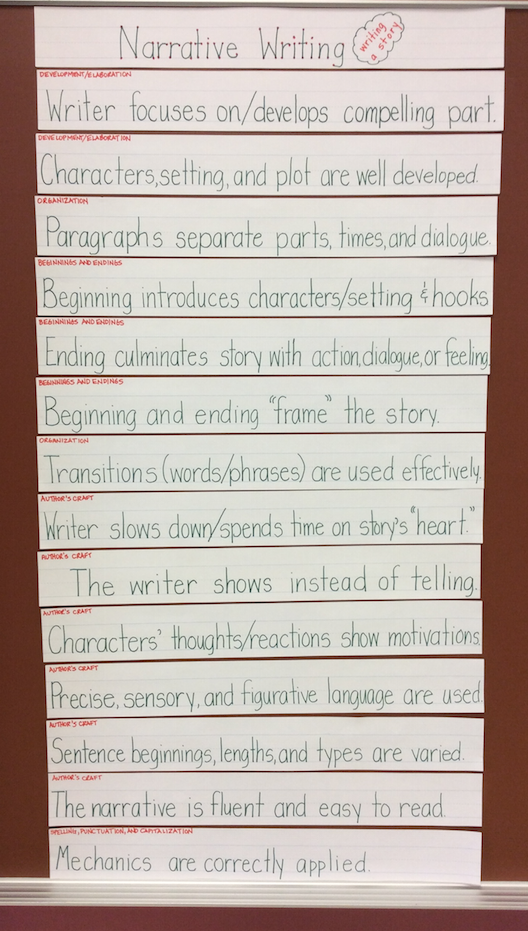
Better Than an Anchor Chart

I find anchor charts to be clear, engaging . . . and limiting. You can create flexible charts using sentence strips, magnets, and tape. Here's how:

Step 1: Generate a list of the ultimate criteria for a specific skill or concept.


Step 2: Gather sentence strips, a marker, tape, and magnets. (In this case, I used outdated refrigerator magnets and cut them in strips.)


Step 3: Create a sentence strip for each criterion. Tape magnet strips to the back of each strip.


After you have created strips for each criterion, you can pick and choose as needed. For example, if my class was working on beginnings and endings, I might only display related strips:


Enjoy!
Brenda


Monday, October 13, 2014

Minds in Bloom

I'm honored to be a guest blogger for Rachel Lynette's blog, Minds in Bloom! If you're a frequent reader, you already know that I'm a passionate advocate of research-based instructional practices that focus on the standards. Check out my blog post to learn how to unwrap a standard, use backward design to create a unit plan, and employ a complete learning cycle to maximize learning.

Enjoy!
Brenda
P.S. If you need task cards for your intermediate-level class, please visit Rachel Lynette's Teachers pay Teachers store!